
Values
Passion, help, community, knowledge, patronage, respect for property.
Social Validation Methodology (MWP) and Minimum Viable Ecosystem (MVE) of the LEGACY AND INNOVATION Foundation.
This page is our methodology (MWP and MVE). Four points first, then phases, cycle and an invitation to work together.
Passion, help, community, knowledge, patronage, respect for property.

Work with the partner: build, try, and quickly reject wrong solutions.

Pilot with people and institutions. First public validation field before a larger deployment.

Lessons return to values. Outside the grant region, responsible further development is possible.
Lessons from step 4 feed back into values and the next trial.
More on working with an idea and protection · Request a pilot · Donate · Rights and licences
Academic entrepreneurship and technology transfer in Poland often lack early validation, while young innovators face a fear of failure. OECD findings indicate that only about one third of people aged 18–30 feel they have the skills to start a business, and more than half cite fear of failure as a main barrier.
The LEGACY AND INNOVATION Foundation (KRS 0001188002, Opatów) proposes a hybrid model: IP protection, research and third-sector structures. The mission joins Legacy (heritage, local identity) with Innovation (social pilots, purpose licences, knowledge transfer).
MWP is a process to reduce innovation risk through controlled non-commercial deployment.

Purpose licence, pilot with an NGO, local government or university, impact metrics, lessons report.
Outside the grant region, an optional commercial path or cooperation with public administration is possible, with value returning to the foundation's statutory goals.
Instead of building a prototype in isolation, MVE joins people, place, knowledge and needs in one project place.

Students, placements, volunteers, local partners.
Workshop, makerspace, a point in a cultural institution.
Operational experience, mentoring, universities.

Diagnosed social needs: seniors, schools, digital exclusion.
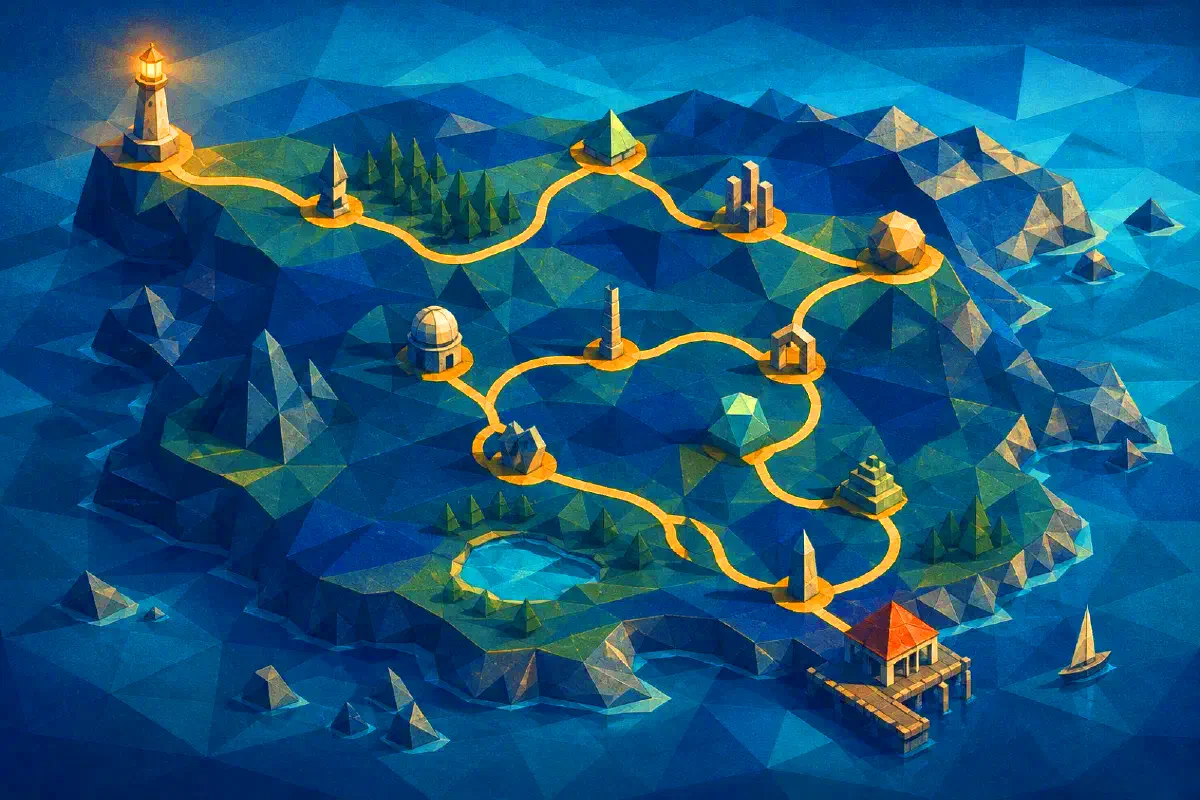
From diagnosing the need to publishing lessons. Amber marks the start; a pavilion marks the finish.
Purpose licences, the method-versus-technology distinction and the official rights pack are on Rights and licences.
| Stream | Contribution | Example partners |
|---|---|---|
| Knowledge | Talent, theses, labs | Universities, student clubs |
| Mentoring | Business, legal, operations | Rotary, industry mentors |
| IP | Non-commercial purpose licences, priority documentation | Rights holders; official UPRP/WIPO sources |
| Social | Diagnosed beneficiary needs | NGOs, local government, care homes, schools |
MVE is a safe innovation sampler: test hypotheses with end users before large commercial capital.
A simplified impact path (inspired by staged methods such as MIT / Explory), adapted for foundation pilots:
| Inputs | Activities | Outputs | Outcomes | Impact |
|---|---|---|---|---|
| Licence portfolio, volunteers, grants | Needs assessment, documentation, prototype, pilot | Trained innovators, prototypes, mentoring sessions | Field performance, skills, less exclusion | Spin-offs, commercialisation outside the grant region, lasting local change |
After a pilot we aim for an Impact Report with a Social Return on Investment (SROI) estimate:
[ SROI = \frac{\sum_{t=1}^{n} \frac{V_t}{(1 + r)^t}}{I} ]
where (V_t) is the value of social effects in year (t), (r) is the discount rate, and (I) is total investment (cash, in-kind, volunteer time). Any sample ratio used on presentation slides is an illustration of the method, not a guaranteed project result.
A 10-slide scenario and the “12 steps…” workshop offer for events such as PARP Future Camp are in:
From patent to impact — PARP Future Camp proposal

Universities and science clubs

Senior organisations

Mentoring organisations

Local governments

Applies for a pilot licence.

Placement or volunteering (2–5 people per project).
Local pilot partner.

IT donation or pilot sponsor.
Contributes rights under a social licence, without giving up the brand.